Friday, November 20, 2015

Ted Honsler story


From: Archie Bleyer
Subject: Re: WWII in Park Record
Date: May 27, 2008 11:06:20 AM MDT
To: Ralph Gates
Cc: Moe Bleyer
Ralph,
What a wonderful story and congratulations to you for helping Ted.  HIs daughter must be most appreciative.  You have helped resolve in Ted two-thirds of a century of life of guilt, anquish, and embarassment that I saw in my parents. 
 
My father was 19 when he left Germany.  About the only experience he talked about was Ellis Island and the Statue of LIberty.  Moe's father was a WWII Vet and always talked about his experiences.  I worried much about the two of them meeting for the first time at our wedding.  They had a great time while we were on our honeymoon.

Archie
On Sun, May 25, 2008 at 8:43 PM, Ralph Gates <frkenn@comcast.net> wrote:

On May 25, 2008, at 10:04 AM, Archie Bleyer wrote:

Ralph,
Thanks for sending me the issue with you and Max Miller on the front cover.
I was particularly impressed that you encouraged Ted Honseler to be featured.
My paternal grandfather died during WWI fighting for the Germans.
My father left Germany in 1929 to avoid being recruited by oppression into the uprising campaign.
My parents were unable to speak about their experiences throughout their lives; it was too painful.
Archie
Thanks for the response, Archie!

       Maybe you will it interested in how I happened to get Ted Honseler to the meeting of WW11 vets.
       I had heard about Ted from a friend of his daughter who lives here in Park City.  About a month before our get together to celebrate Armistice Day (now Veteran's Day, of course) I had contacted his daughter and told her I wanted to invite him to our group.  She vetoed it in no uncertain terms because, as she said, he didn't want people to know he was on the other side of the fence.  So I did not make any further attempt until the day before our special meeting when I attempted to call the daughter one more time.  She wasn't there but Ted answered the phone!!  I was a little reluctant to ask him directly so I told him that we old Vets were getting together for dinner.  I guess I squeezed him a little  but eventually he said yes he would be willing to come.
       None of the rest of the group knew anything about him or my contacts with him.  So when I picked him up and brought him no one had any idea who he was and certainly no inkling that he was a German vet.
       He and I were the last two to arrive in the special dinning room and, in turn, the other guys were one at a time giving a very short synopsis of their war time experience.  When it became Ted's term I stood up and said I wanted to introduce a new found friend who had also been in the war for a couple of years.  I proceeded to inform them that "Ted" and I had a couple of things in common.  Firstly, that both our fathers had been in the trenches in France in the First WW!   Secondly, that we were probably the youngest two vets here who had seen two years of service.  And on top of that he was only 80 and I, 82.  They immediately realized that Ted must have gone in when he was only 16 (Later they found out that was indeed true and he hadn't lied about his age.)
       Please realize that the group still had no idea that he was German.  So next I said there was something quite dissimilar about Ted's and my experience.  Namely, when I returned home to Nashville,  everything was as peaceful and as undisturbed as when I had left two years earlier.  But when Ted returned to his home, it wasn't there.  It and the whole town had been totally destroyed!  There faces showed bewilderment and as I found out shortly,  they were wondering where earthquakes or hurricanes had done this back then.
       But when I said his hometown was Essen, Germany there were a couple of soft gasps of realization.  Particularly from the four or so of the group who had been in the 8th Airforce  -- two as pilots of B-17's and two as P-38 or P-51 fighter pilots who had escorted the bombers as they leveled Essen!!
       My last part of his story was letting them now that Ted was a little reluctant earlier to come tonight because he always felt he had been on the "other side of the fence" but I had tried to assure him there was no longer any fence.  There was actually evidence of tears in some of the eyes when Ted, in his strong German accent, told of his mother not letting him join the "Hitler Youth" when he was of typical Boy Scout age and that was where the fun seemed to be when 12 years old.  He was drafted when 16 and sent to the Eastern Front to fight the Russians where he was eventually captured when the Russians, shortly before the end of the war, over ran their defenses near Budapest.  The Russians were racing for Berlin and he and many others were lucky and left to fend for themselves rather than winding up in the hands of Russians as prisoners.  So he made his way to Salz!burg where he surrendered to an American Prisoner of war camp.
       Eventually American trucks took him back to Essen.  He said there were no buildings standing but his parents were alive and living in a bunker.  Rebuilding his town started immediately but he emigrated to the US in a few years with his young wife, sponsored by a relative who had already been here for a number of years
       A couple of weeks later, I got his visual autobiography down with my camcorder.  How great for me has been this whole experience!!     --  Ralph


--
Archie Bleyer, MD
St. Charles Medical Center, Bend, Oregon
Cell 541-610-4782
Office 541-383-6998

Sunday, November 8, 2015

Pictures you don't see every day


Here are some very rare pics you don't see everyday.......
 
1903__080814
 

A 10 x 15-foot wooden shed where the "Harley-Davidson Motor Company  " started out in 1903
 
 
1912__080814
Testing football helmets in 1912
 
 
1920__080814
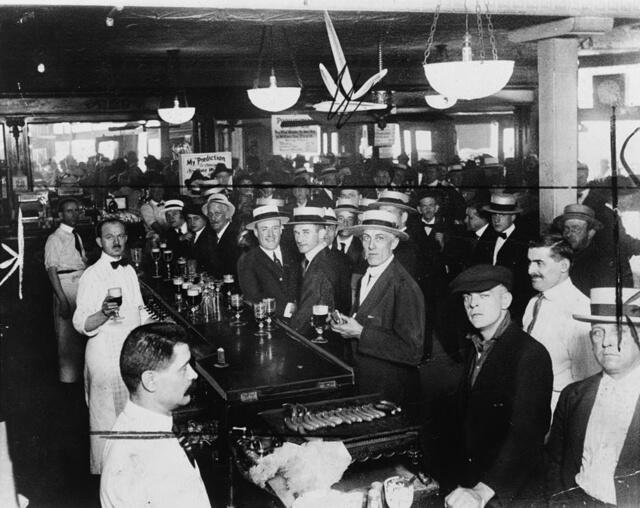
A bar in New York City, the night before prohibition began,1920
 
 
1920s__080814
Mount Rushmore Before Carving, 1920s
 
 
1923_080814
Traffic jam in New York, 1923
 
 
1926_080814
A quiet little job at a crocodile farm in St. Augustine, Florida, 1926(UPDATE: well, an alligator farm of course, as Roy notes in the comments below)
 
 
1929__080814
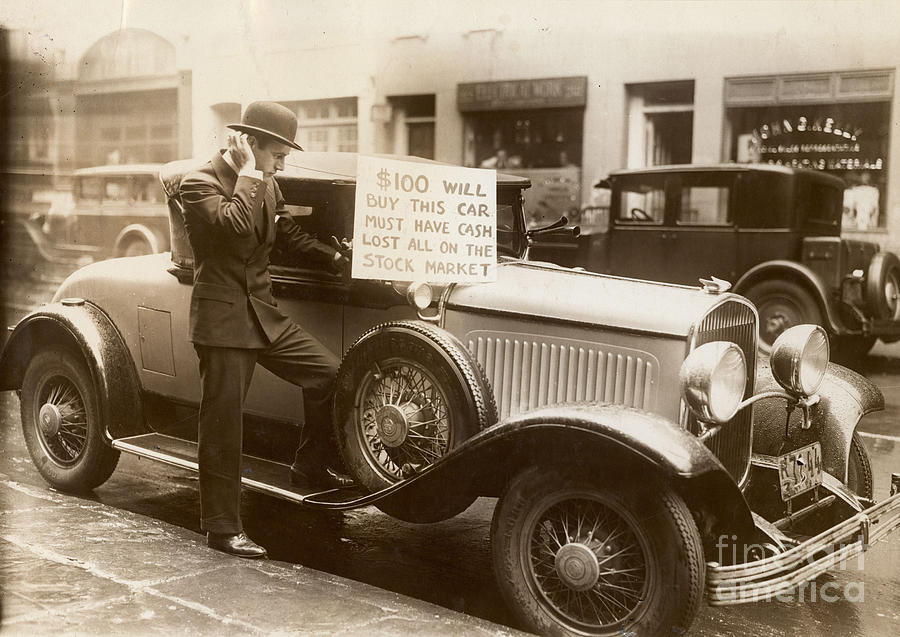
World economic crisis, 1929
 
 
1930__080814
Central Park in 1930
 
 
1930B__080814
Last four couples standing at a Chicago dance marathon, ca. 1930
 
 
1930c
Meeting of the Mickey Mouse Club, early 1930s
 
 
1938__080814
Confederate and Union soldiers shake hands across the wall at the 1938 reunion for the Veterans of the Battle of Gettysburg
 
 
1939_080814
When they realized women were using their sacks to make clothes for their children, flour mills of the 30s started using flowered fabric for their sacks, 1939
 
 
1940_080814
NY, Coney Island, 1940
 
 
1942__080814
The thirty-six men needed to fly and service a B-17E in 1942
 
 
1948__080814
A man begging for his wife  's forgiveness inside Divorce Court. Chicago, 1948
 
 
1949__080814
Three young women wash their clothes in Central Park during a water shortage. New York, 1949
 
 
1951_080814
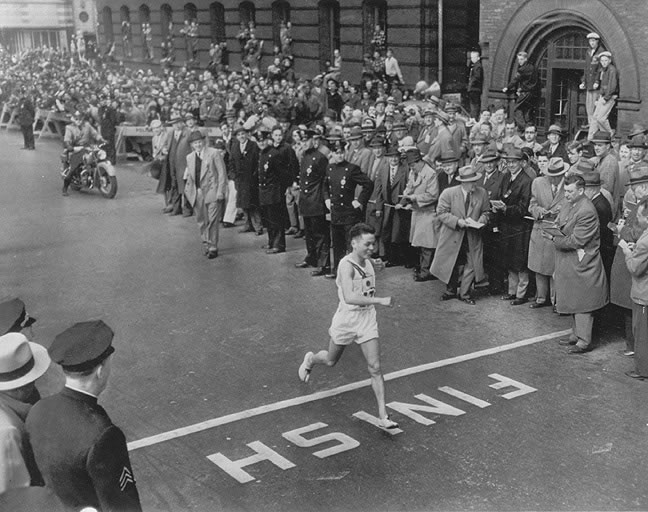
19 year-old Shigeki Tanaka was a survivor of the bombing of Hiroshima and went on to win the 1951 Boston Marathon. The crowd was silent as he crossed the finish line. (UPDATE: As Peter notes in the comments below, "Tanaka was not exactly "a survivor of the bombing of Hiroshima  " — when the bomb was dropped, he was at home, about 20 miles from the site. He saw a light and heard a distant rumble, but was personally unaffected by the bomb.")
 
 
1955__080814
Florida  's last Civil War veteran, Bill Lundy, poses with a jet fighter, 1955
 
 
1960s_100814
NASA scientists with their board of calculations, 1960  ′s
 
 
1963_080814
Muhammad Ali  's fists after the fight with Cooper, 1963
 
 
1969_080814
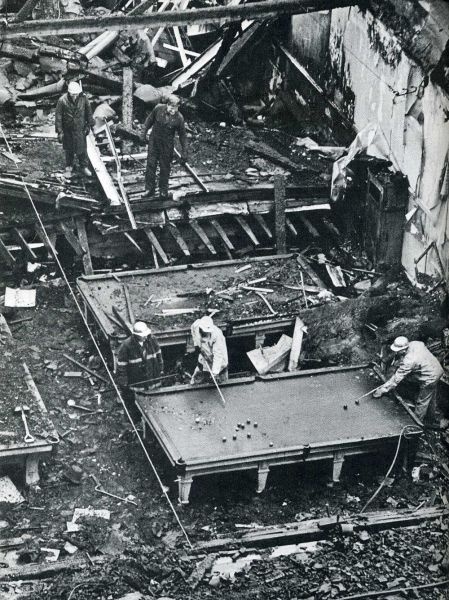
New York firemen play a game after a fire in a billiard parlor, 1969
 
 
1971_080814
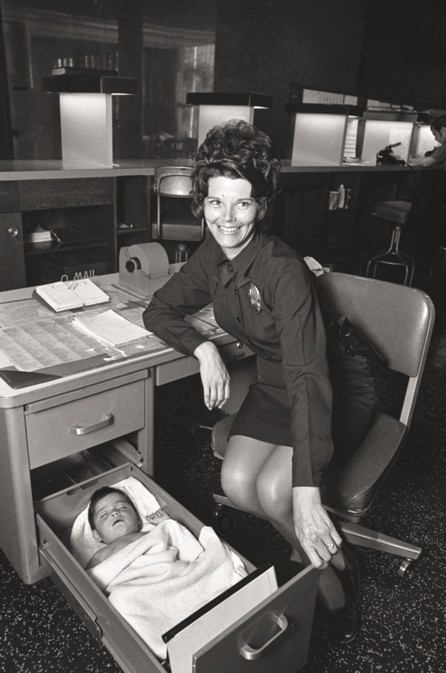
An abandoned baby sleeps peacefully in a drawer at the Los Angeles Police Station, 1971
 
 
1972_080814
Boy hiding in a TV set. Boston, 1972 by Arthur Tress
 
 
1974__080814
A spectator holds up a sign at the Academy Awards, April 1974
 
 
1975_080814
Robert De Niro  's cab driver license. In order to get into character for the film Taxi Driver, he obtained his own hack license and would pick-up/drive customers around in New York City.
 
 
1983__080814
Nancy Reagan sits on the lap of Mr. T, dressed as Santa, 1983
 
 
1985_080814
Ronald Reagan wearing sweatpants on Air Force One, 1985
 

Saturday, October 31, 2015

Shortly before Pearl Harbor

August 7,1941

Pearl Harbor was still 4 months in the future.  
My mother, father, three brothers and I were returning from our annual two weeks vacation on Onaway Island in Sunset lake in the Chain of Lakes near Waupaca, Wisconsin, heading home to Nashville, Tennessee.  Dad's birthday was July 31 and mother had arranged for all of us to spend a night overlooking  Lake Michigan and Grant Park at the historic Stevens Hotel on Michigan Avenue in Chicago. 
My two younger brothers, Larry and Carl, were eleven  and nine years old.   Brother Daniel was nineteen and a second year student at the University of Illinois.  I was in my senior year in high school.  

We had gone to sleep fairly early and at about two o'clock in the morning, Dad awakened Daniel and me and said "I want you to come and look out the window and listen!"  As soon as we came close to the window we could hear a quiet "brump, brump, brump bump bump" sound of a drum beat and then saw down below on Michigan Avenue soldiers marching.  I remember him saying :"We will soon be in another war".Shortl

Tuesday, October 27, 2015

Money sent home by illegals

Another early morning musing    5/18/10

I don't fully understand why these crazy ideas wake me up at such awful hours, like 4:15 this morning, and eliminate the possibility of any further badly needed sleep.  I supposedly should get a good 7 or so hours of sleep at night for good health at my age.
It must be my sub-conscience or something like that, with which I was wrestling, while sleeping, over a discussion I heard on a TV or radio program a day or so ago.  It was part of some arguments about the "illegal immigration problem" that is rising to center stage with the recent Arizona law -- that will surely "cause all sorts of racial discrimination" -- according to many of the supposedly well-meaning people in our country, in Mexico, and even in the UN (!) and the rest of the world.  To top it all off we are led to believe that many of these well-meaning people have never even read the law.  So emotions and prejudices run wild.
So here is just one more log to throw on the fire.  I believe some part of the illegal alien controversy is responsible for the most efficient and effective from of international relief that we can give.  Consider $100 that goes directly from the working illegal to his family.
Every time we pay some of these illegals, part of that money goes quickily and directly to a needy family in Mexico as an example.  If we were to help those same needy families through typical government largesse, that $100 would be collected in taxes, moved to Washington, subjected to applicable government overhead, sent  to some agency or bureaucracy in Mexico, subjected to their overhead and finally trickled down to the family.  How much would they get?  -- $10 perhaps?
I wouldn't deny that I am postulating a favorable, legitimate use of the directly sent $100.  Maybe some would go toward drugs, etc., but I believe most of the illegals send it for better use.
So in one sense we who pay the illegals are making contributions that may be even more effective and efficient than if we had given $100 to our church, synagog,  or some non-profit relief organization for their distribution.

Perhaps we should consider giving  the "Payor" a tax deduction.

Expatriots - Beverly, Pauline, and Hope

Carpe Diem!!  Carpe Diem!!   (12/17/07)

Dear Beverly, Pauline, and Hope,
I am inclined to awaken in the wee hours of the moment with ideas spinning around in my head that occasionally seem magically simple (to me, that is!) and I have to write them down -- perhaps to forget appropriately or frequently to pursue.
This early morning I want to tell you how excited I am about your brief conversation around the bridge table yesterday, 12/17/07, when you all recounted a variety of experiences as temporary expatriates (?)  in Europe after WW ll.  
When I tried to tell you how exciting I felt your conversation was, the immediate tendency seemed  to be an attempt to deprecate the importance of your experiences.  Please admit to something more realistic.  While there may have been many other women is similar situations, your were unique as American wives and mothers (in addition to other working responsibilities you may have had) in a European culture that is changing and, some years from now, may be remembered wistfully, fearfully, joyously, or even angrily.
That genre of experiences will surely be written by others and valued historically.  But how much more prized  it would be to see and here directly from you in unrehearsed and casual interplay!  Whatever might result from his would be for you alone to control.  It is my humble but strong opinion that your descendants would prize this highly.  I can promise you that because of my experiences already with other camcorder tapes that I have made, put on VHS or DVD format and given to the participants for their children and grandchildren.
So please think seriously about getting together again the first meeting of the Senior Citizens after New Years, 1/3/08, and spending some relaxed time in front of my camcorder.  It would not be appropriate to do anything more in planning for this other than just to recall now a variety of daily things that were a part of your life.  If you happened to have an interview with the Crowned Heads of Europe or the Pope  that would be of interest but certainly not the main thrust of this exercise.

Can you imagine how interesting it would be for you if you could see and hear you parents or grandparents talk about their lives -- perhaps in the "old country" if they were immigrants, or during the "roaring twenties" or the depression.  We live in changing times now, perhaps momentously so and I am reminded of that WW ll song  --  "The last time I saw Paris, her heart was young and gay, no matter how they change her, I'll remember her that way".  So let's remember how Europe was not too many years ago.

Long time war with Islam


Why the Marine Hymn Contains the Verse "To the Shores of Tripoli"
 
 
Most Americans are unaware of the fact that over two hundred years ago the United States had declared war on Islam and Thomas Jefferson led the charge!
 
At the height of the eighteenth century, Muslim pirates were the terror of the Mediterranean and a large area of the North Atlantic.
 
They attacked every ship in sight, and held the crews for exorbitant ransoms.    Those taken hostage were subjected to barbaric treatment and wrote heart-breaking letters home, begging their government and family members to pay whatever their Mohammedan captors demanded.
 
These extortionists of the high seas represented the Islamic nations of Tripoli, Tunis, Morocco, and Algiers collectively referred to as the Barbary Coast and presented a dangerous and unprovoked threat to the new American Republic.
 
Before the Revolutionary War, U.S. merchant ships had been under the protection of Great Britain.      When the U.S. declared its independence and entered into war, the ships of the United States were protected by France. However, once the war was won, America had to protect its own fleets.
 
Thus, the birth of the U.S. Navy.    Beginning in 1784, seventeen years before he would become president, Thomas Jefferson became America’s Minister to France.    That same year, the U.S. Congress sought to appease its Muslim adversaries by following in the footsteps of European nations who paid bribes to the Barbary States rather than engaging them in war.
 
In July of 1785, Algerian pirates captured American ships, and the Dye of Algiers demanded an unheard-of ransom of $60,000.   It was a plain and simple case of extortion, and Thomas Jefferson was vehemently opposed to any further payments.    Instead, he proposed to Congress the formation of a coalition of allied nations who together could force the Islamic states into peace.     A disinterested Congress decided to pay the ransom.
 
In 1786, Thomas Jefferson and John Adams met with Tripoli's ambassador to Great Britain to ask by what right his nation attacked American ships and enslaved American citizens, and why Muslims held so much hostility towards America, a nation with which they had no previous contacts.
 
The two future presidents reported that Ambassador Sidi Haji Abdul Rahman Adja had answered that Islam "was founded on the Laws of their Prophet, that it was written in their Quran that all nations who would not have acknowledged their authority were sinners, that it was their right and duty to make war upon them wherever they could be found, and to make slaves of all they could take as Prisoners, and that every Musselman (Muslim) who should be slain in Battle was sure to go to Paradise."
 
Despite this stunning admission of premeditated violence on non-Muslim nations, as well as the objections of many notable American leaders, including George Washington, who warned that caving in was both wrong and would only further embolden the enemy, for the following fifteen years the American government paid the Muslims millions of dollars for the safe passage of American ships or the return of American hostages.    The payments in ransom and tribute amounted to over twenty percent of the United States government annual revenues in 1800.
 
Jefferson was disgusted.   Shortly after his being sworn in as the third President of the United States in 1801, the Pasha of Tripoli sent him a note demanding the immediate payment of $225,000 plus $25,000 a year for every year forthcoming.     That changed everything. Jefferson let the Pasha know, in no uncertain terms, what he could do with his demand.    The Pasha responded by cutting down the flagpole at the American consulate and declared war on the United States.     Tunis, Morocco, and Algiers immediately followed suit.     Jefferson, until now, had been against America raising a naval force for anything beyond coastal defense, but, having watched his nation be cowed by Islamic thuggery for long enough, decided that is was finally time to meet force with force.
 
He dispatched a squadron of frigates to the Mediterranean and taught the Muslim nations of the Barbary Coast a lesson he hoped they would never forget.    Congress authorized Jefferson to empower U.S. ships to seize all vessels and goods of the Pasha of Tripoli and to cause to be done all other acts of precaution or hostility as the state of war would justify.
 
When Algiers and Tunis, who were both accustomed to American cowardice and acquiescence, saw the newly independent United States had both the will and the right to strike back, they quickly abandoned their allegiance to Tripoli.    The war with Tripoli lasted for four more years, and raged up again in 1815.    The bravery of the U.S. Marine Corps in these wars led to the line to the shores of Tripoli in the Marine Hymn, and they would forever be known as leathernecks for the leather collars of their uniforms, designed to prevent their heads from being cut off by the Muslim scimitars when boarding enemy ships.
 
Islam, and what its Barbary followers justified doing in the name of their prophet and their god, disturbed Jefferson quite deeply.
 
America had a tradition of religious tolerance, the fact that Jefferson, himself, had co-authored the Virginia Statute for Religious Freedom, but fundamentalist Islam was like no other religion the world had ever seen.    A religion based on supremacism, whose holy book not only condoned but mandated violence against unbelievers, was unacceptable to him.     His greatest fear was that someday this brand of Islam would return and pose an even greater threat to the United States.
 
This should bother every American.    That Muslims have brought about women-only classes and swimming times at taxpayer-funded universities and public pools; that Christians, Jews, and Hindus have been banned from serving on juries where Muslim defendants are being judged; Piggy banks and Porky Pig tissue dispensers have been banned from workplaces because they offend Islamist sensibilities; ice cream has been discontinued at certain Burger King locations because the picture on the wrapper looks similar to the Arabic script for Allah; public schools are pulling pork from their menus; on and on and on and on.
 
Is it death by a thousand cuts, or inch-by-inch as some refer to i? Most Americans have no idea that this battle is being waged every day across America.    By not fighting back, by allowing groups to obfuscate what is really happening, and not insisting that the Islamists adapt to our own culture, the United States is cutting its own throat with a politically correct knife, and helping to further the Islamists agenda. Sadly, it appears that today's America's leaders would rather be politically correct than victorious!


Saturday, October 24, 2015

Are we at War? --January 2003

Just one possible scenario January 2003

To all my friends who together with me try to figure out what we should do!!

When we are aU talking at the same time it seems difficult, in my opinion, to stay focused on the above subject. It is so easy to fall into Bush bashing and why we are in current difficulties. I am not at this writing attempting to be an apologist for President Bush. I believe the mess we are in is the result of something far beyond just Bush.

At the outset, I believe we are indeed in the early stages of a major world war. So for the moment, try to accept this as just an hypothesis and see if my analogies make any sense. (If you disagree with this, l hope you will put in writing a different analogy and a scenario of your own as to what we might do.)

We (the USA) were ill prepared for either WWI or WWIl. When we finally were forced to enter these conflicts, we made several feints that were not decisive victories but were appropriate in the overall conflict while we marshaled our strengths and moved slowly in the right direction. It took a long time with island hopping along the way before we could even consider attacking Japan directly. So when I hear that we should have attacked Iran (or North Korea) rather than Iraq, I am reminded that it is necessary to choose battles carefully. And if, once again, you are willing to accept my thesis that we are in a major world war, perhaps it is reasonable to consider that our leaders chose an acceptable feint.

I try to make an analogy of our current situation like a boil on my body that has been slowly growing for several years (at least since early attacks on our culture by Muslim terrorists in the 1980s). I don't have a certain explanation for why this boil is on my body. Some folks (the Mea Culpa group) tell me it is my fault for doing something bad that caused the infection. Maybe that is so but maybe it is simply the fault of my less-than-perfect humanity and my genes. Now what should I do about this boil? Let it slowly grow until it festers? Or maybe my body will cure it without any action by me! If it does continue to get worse, I expect I will eventually be forced to lance it, go through painful time and recover. If I follow the latter course of action I feel the healing will be more difficult and I expect I would be better off doing something about it now since it is growing rapidly.